How to Get Severe-Weather Alerts on Your Phone
The three real ways to get severe-weather warnings on your phone, how to switch them on, and why the safest setup uses more than one.

By Xavier Santos
Co-founder & CTO
The safest setup uses two together. Turn on Wireless Emergency Alerts (WEA), the free government warnings your phone receives automatically for threats like tornadoes and flash floods, and pair them with ZoneWatch, a weather intelligence platform that models conditions for the exact places you save. WEA is the floor: free, automatic, and county-wide. ZoneWatch fills what it leaves out, including lightning, ordinary thunderstorms, hail, and custom thresholds, with alerts tied to your address instead of a broadcast area.
What are the three ways to get severe-weather alerts on your phone?
ZoneWatch or a comparable weather intelligence platform, Wireless Emergency Alerts, and a NOAA Weather Radio. These are not competing choices where you pick a winner. Each one covers a gap the others leave open, and the households that come through severe weather best are the ones running more than one.
Think of it as layers. WEA is the free floor that reaches your phone with no setup and no account. ZoneWatch is the layer that actually watches your address, catching the hazards WEA was never built to send and giving you time before the official warning is published. A NOAA Weather Radio is the backstop for the night the power and the cell towers both go down.
- ZoneWatch, a weather intelligence platform: Runs its own models against the specific locations you save and issues its own alerts, rather than relaying warnings someone else already published. Covers lightning, hail, wind, heat, ice, and rain thresholds that government alerting never fires for, and targets your neighborhood instead of your county. Available on the web, iOS, and Android.
- Wireless Emergency Alerts (WEA): Free, automatic alerts broadcast from cell towers for warnings such as Tornado, Flash Flood, Hurricane, Storm Surge, Snow Squall, Dust Storm, and Extreme Wind. No app or signup, and they work even if you have no data connection. Keep them on. The limits are that they fire only for that short list and target by tower coverage rather than your precise location.
- NOAA Weather Radio: A dedicated receiver that sounds an alarm for warnings in the counties you program in. It keeps working when cell service and power are patchy, which is exactly when you are most exposed, but it is tied to your home or office and you have to keep a device charged or plugged in.
How do I turn on Wireless Emergency Alerts on iPhone and Android?
Start here, because it takes two minutes and it is free. WEA is usually on by default, but it is easy to switch off by accident, silence after a loud test, or leave off on a family member’s phone. Confirm it is enabled on every phone in the house, then move on to the layer that does the real work.
The exact wording changes with your phone and carrier, but the path is short on both platforms:
- On iPhone: Open Settings, tap Notifications, and scroll to the bottom to Government Alerts. Turn on Emergency Alerts, Public Safety Alerts, and AMBER Alerts. National (Presidential) alerts stay on and cannot be disabled.
- On Android: Open Settings, tap Safety & emergency, then Wireless emergency alerts (on some phones it lives under Settings then Notifications). Switch on Extreme threats, Severe threats, and AMBER Alerts. Some Android phones let you keep Extreme alerts while muting Severe.
- Check them twice a year: Turning these off silences the government’s free warnings. Verify they are on when you test your smoke detectors, and make sure kids’ and older relatives’ phones are set too.
What will Wireless Emergency Alerts never warn you about?
This is the part most people never find out until it matters. WEA was designed for a narrow set of imminent, life-threatening events, and it does its job well. But the list of what it does not send is long, and it includes most of the weather that actually disrupts a normal week.
Lightning is the clearest example. Around 25 million flashes hit the United States in a typical year and WEA does not cover a single one of them. There is no lightning category in the system at all.3
Severe thunderstorms are the bigger surprise. Since August 2021 the National Weather Service has only pushed a WEA for warnings tagged "destructive," meaning 80 mph winds or baseball-size hail, and nationwide only about 10 percent of severe thunderstorms reach that bar in a given year. The other 90 percent, the ones with damaging wind and quarter-size hail that still take out a roof or a windshield, never buzz your phone at all.1
- Lightning, entirely: No category exists. If you need to know a strike just landed three miles from the soccer field, WEA will never tell you.
- Roughly 90% of severe thunderstorms: Only warnings tagged "destructive" push to phones, and about one in ten severe storms qualifies. The rest are silent.
- Hail below the destructive threshold: Quarter and golf-ball size hail can total a roof and a windshield without ever triggering an alert.
- Heat: Heat is among the deadliest weather hazards in an average year, and Heat Advisories and Extreme Heat Warnings do not go out over WEA.
- Winter storm timing: Snow Squall Warnings push, but Winter Storm Watches, Warnings, and Advisories do not. You get no help with the question that matters most: when does it start at my house?
- Anything on your terms: There are no thresholds, no saved locations, and no way to say "tell me when wind at the job site passes 40 mph." WEA sends what it sends.
How does ZoneWatch alerting differ from county-level WEA?
WEA is built for broad broadcast, not your exact spot. Alerts go out to an area sized to the warning, historically as large as a whole county. Carriers must now hit the target with very little overshoot, but the National Weather Service still notes that an alert can reach phones outside the actual warning area depending on how far the towers broadcast. So WEA can over-warn, buzzing you when the danger is miles away, or under-warn, staying silent when your street is threatened but the broadcast did not reach you.
ZoneWatch was built to close that gap. It is a weather intelligence platform rather than a weather app, running on the web, iOS, and Android, and it does not recycle government warnings. It runs its own models against custom 10-, 25-, or 50-mile zones you draw around the places that matter, your home, a child’s school, or a job site, and issues its own alerts for those spots instead of a county line. That cuts both ways: you hear about the storm actually bearing down on your street, and you stop hearing about the one forty miles away on the far side of the county.
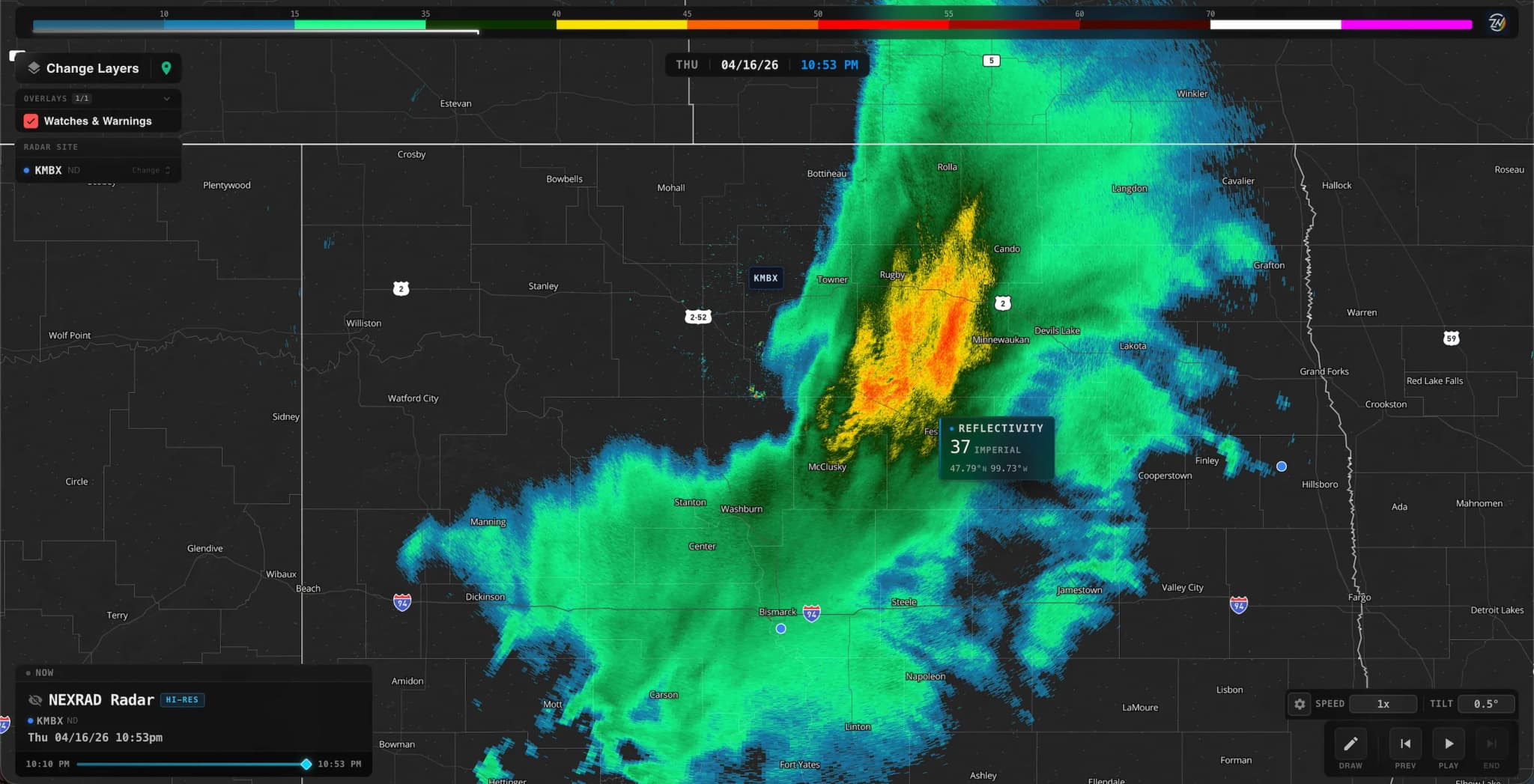
Because those alerts come from modeled conditions rather than a warning someone else has already published, they can arrive a long way ahead of the official product. For hazards that can be forecast in advance, such as winter storms, extreme heat, and damaging wind, that often means hours or even days of extra notice for your specific area. For fast hazards like lightning and hail, where nothing is predictable days out, the gain is measured in minutes and in precision: an alert keyed to your address rather than a broadcast area. ZoneWatch adds real-time lightning detection with the distance and bearing to the nearest strike, high-resolution radar (HRRR, RAP, and NAM-3km), storm tracking, and hail and wind reports.
What should you look for in a weather alerting platform?
Quality varies enormously, and the difference is not the icon on your home screen. Most weather apps do little more than repackage the same government warnings your phone already receives free, wrapped in ads. If that is all a product does, it cannot warn you any earlier than WEA does, because it is waiting on the same published warning you are.
The questions worth asking are short, and they separate a genuine intelligence platform from a wrapper:
- Does it issue its own alerts, or relay someone else’s?: This is the one that matters most. A platform running its own models against your location can alert on conditions before an official product exists. A relay cannot, by definition.
- Does it alert per location, or per county?: Saved locations with their own zones mean you hear about your street. County-level alerting means you hear about everywhere, and eventually you stop listening.
- Can you set your own thresholds?: Wind over 40 mph at a job site, ice at the school run, lightning inside 25 miles. Fixed government categories cannot express any of that.
- Does it cover lightning in real time?: Distance and bearing to the nearest strike, updating continuously. This is the single biggest hole in government alerting and the easiest to check for.
- How good is the radar underneath?: High-resolution radar built on professional short-range models, refreshing in minutes, with future radar you can scrub. A slow, blocky radar loop is a sign the data pipeline behind it is thin.
- How much noise does it make?: An alerting tool you mute is worse than none. Filtering that keeps the focus on your locations is what keeps notifications meaningful.
How do I set up alerts that actually reach me?
Layer the two, then tune the one you can tune. WEA needs nothing beyond the two-minute check above. ZoneWatch is where you decide what is worth being interrupted for, and a few minutes of setup is the difference between alerts you act on and alerts you swipe away.
Do this once and it keeps working: save every location that matters, not just home. Set the zone radius to match how much warning you need, since a 50-mile lightning zone gives an outdoor crew time to pack up while 10 miles is right for deciding whether to bring the dog in. Set thresholds around the things you actually do, then put the platform on every phone in the household so the alert reaches whoever is closest to the problem.
Then leave WEA on underneath all of it. The two are not redundant. WEA keeps working when your data connection does not, and it carries the legal weight of an official warning. ZoneWatch gives you the earlier, more precise, lightning-aware picture and the hazards WEA never sends. Together they cover each other’s blind spots, which is exactly what you want when the weather turns. The National Weather Service remains the official source for warnings; the point of the second layer is to know sooner, and to only hear about what actually threatens the places you care about.
Frequently asked questions
Xavier Santos is the co-founder and CTO of WeatherWise Innovations, the U.S. company behind ZoneWatch, and the engineer and designer behind the product. He builds the high-resolution radar, forecast models, and real-time lightning, hail, and flood detection that power its alerts, along with the iOS, Android, and web apps, and has founded and shipped several other software and AI products.
Related posts
The Best Weather App for Severe Weather & Real-Time Alerts
The features that actually matter when a storm is minutes from your door.
Sina · July 24, 2026 · 6 min
Lightning Safety: How to Protect Your Family
Lightning is constant, and most of its damage never makes the news. Here’s what keeps your family and your home safe when storms roll in.
Xavier · July 24, 2026 · 8 min
Get alerts built for your exact spot
ZoneWatch watches custom 10-, 25-, and 50-mile zones around the places you care about and pings you the moment lightning or severe weather moves in.